
Visible storage ideas are gaining attention for a simple reason: more containers do not necessarily mean a more organized home. A cabinet can be packed with matching bins and still be frustrating if you cannot reach the one you need. These visible storage ideas work best when you make everyday belongings easy to see, retrieve, and return, while using color, texture, and thoughtful furniture to keep each room welcoming.
On October 26, 2026, Real Simple published advice from professional organizers about underused shelves, deep cabinets, drawer divisions, and poorly arranged clothing. Also published that day, Southern Living explored a monthly decluttering routine for the spaces where clutter returns fastest. These are timely articles about a practical, longer-running approach, not proof that a wholly new organizing method appeared overnight.
In this guide
- Why visible storage is resonating now
- Audit your home before buying organizers
- Visible storage ideas for each room
- Make functional storage look inviting
- A realistic weekend plan
- Mistakes to avoid
- Frequently asked questions
Why visible storage is resonating now
Organizing advice often emphasizes how many items fit into a space. Capacity matters, but it is only part of the problem. The real test is whether you can get a lunch container out without moving five others, identify a shirt without emptying a drawer, or put away a blanket without finding somewhere to shift a stack of magazines.
This thinking suits the wider design direction of 2026. An October 13 National Association of Realtors design report described a move toward layered, personal interiors rather than empty-looking rooms. Its discussion of IKEA and Houzz research points to a growing interest in homes that feel collected and comfortable. Practical storage should support that feeling, not erase everything that gives a home character.
That creates a useful middle ground between two extremes. You do not need to hide every possession behind a closed door. You also do not need to display every toy, cord, bag, or spare cleaning bottle. A few visible collections and attractive objects can share a room with closed storage for visually busy essentials.
What a good storage system actually does
A useful system passes five everyday tests. You can recognize what belongs where. You can retrieve an item with little effort. The location is easy to reach for the person using it. There is room to return it without rearranging everything. The arrangement looks pleasant enough that you want to maintain it.
Consider a shelf of twelve identical opaque boxes. They may look neat in a photograph, but labels become vital if you cannot identify what is inside. Six open baskets can be easier for children’s toys, while two lidded boxes are better for infrequently used items. The right mix of visible storage ideas depends on the contents, not the look of the product listing.
Audit your home before buying organizers
Start with the problem rather than the product. Choose one cabinet, drawer, or corner that slows down a daily task. Empty it completely, wipe the surface, and group its contents into categories. Put damaged or unusable items aside for appropriate disposal. Move duplicates and rarely used items to a more suitable location if they deserve to be kept.
Then count how often you need each category. Everyday belongings earn the easiest access. Weekly items can sit slightly higher or deeper. Seasonal decorations and extra supplies can live in harder-to-reach spaces, provided their weight and storage conditions are appropriate.
Measure the opening, not just the interior
Before buying a bin or turntable, measure the interior width, depth, and height. Then measure the usable opening. A cabinet may be wide inside but have a hinge that blocks a large container from sliding out. A deep drawer might clear the cabinet when opened yet lack the height for tall jars.
Leave space for your fingers and for lifting the container. Check that baskets do not scrape doors, that handles clear shelves, and that nothing blocks vents, outlets, plumbing access, or appliance instructions. If the proposed organizer fits on paper but must be tilted awkwardly to get it out, choose a smaller size.
Run a low-cost trial first
Use existing boxes, trays, and baskets to test the layout for several days. A temporary label made from paper and removable tape helps everyone understand the categories. If the system works, replace worn or mismatched containers only where necessary. This avoids buying expensive matching sets before you know the right dimensions.
A quick photo of the cabinet before and after is useful for your own planning. It also reveals whether the new setup truly improves access or merely photographs better. A successful change should shorten an ordinary task, such as finding baking supplies or putting laundry away.
Visible storage ideas for every room
1. Living room: combine display shelves with hidden storage
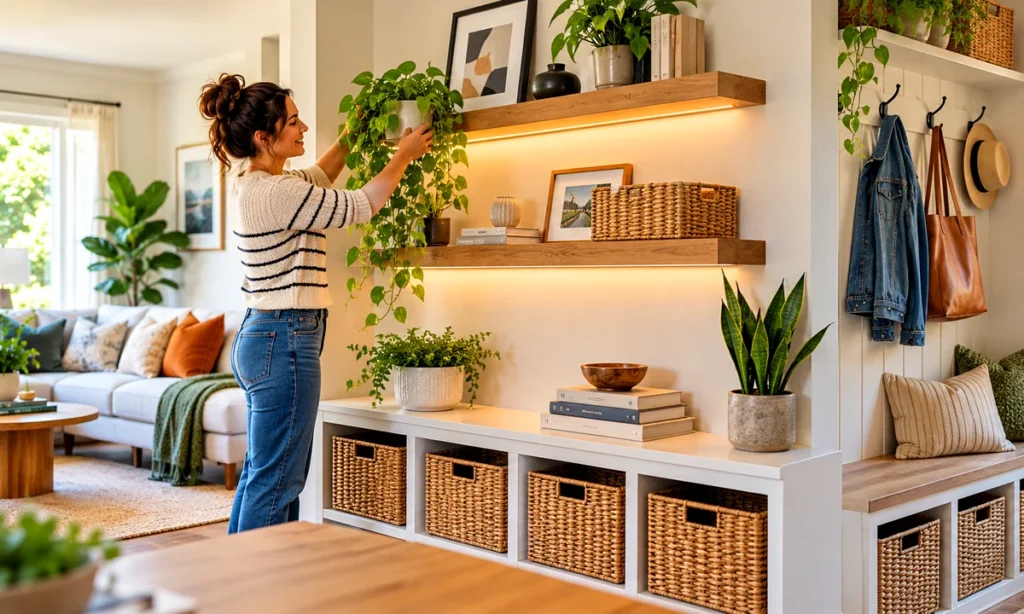
The living room is often asked to serve several purposes. It may hold games, school supplies, remote controls, exercise equipment, books, and guests. One long line of exposed shelves can make all of these categories compete visually, especially in a compact room.
Instead, create two distinct zones. Use open shelves for a modest number of books, plants, and meaningful objects. Keep less decorative items in closed cabinets, woven baskets, or a storage ottoman. Place the everyday remote-control tray near the seat where it is used. Keep game pieces together rather than scattered across multiple drawers.
If you want new wall storage, follow our guide on how to install floating shelves before drilling.
Choose a few repeated materials, such as warm wood, a favorite color, and one basket texture. Repetition creates visual calm without forcing everything to match. If a shelf looks overcrowded, remove some objects rather than buying extra decor to make the grouping appear intentional.
2. Kitchen: stop stacking everything behind everything else
In kitchens, visible storage ideas become useful when deep shelves stop working. Kitchen storage becomes inefficient when the back of a cabinet disappears from daily view. Deep shelves are not automatically bad, but they reward containers that bring an entire category forward. Put baking supplies in one handled bin, small packets in another, and commonly used jars where their labels face the front.
For baking sheets, chopping boards, and narrow trays, a stable upright divider may prevent a pile that has to be dismantled each time you cook. Shelf risers can make better use of vertical space when the weight is appropriate. A turntable may help in a corner cabinet, but only if the items are stable and the cabinet is roomy enough for it to rotate.
Food safety and product suitability remain important. Use food-contact containers where direct contact is intended. Keep cleaning chemicals away from food and out of children’s reach. Avoid transferring pantry products into unlabeled containers if you will lose expiration dates, allergens, cooking instructions, or other useful information.
3. Bedroom: make clothing easier to scan
Most people know the frustration of a beautifully folded drawer that turns messy after a few busy mornings. Rather than stacking shirts into tall piles, arrange suitable items vertically so several choices are visible at once. Low dividers can keep socks, workout clothes, and accessories from spreading into each other’s space.
Do not force delicate or bulky clothing into a folding method that damages fabric or prevents the drawer from closing. A few sturdy sweaters may still store better flat on a shelf. Grouping by item type is often more useful than a complicated color system, though colors can help you find garments quickly.
Give frequently worn outfits the most comfortable reach. A hook inside the closet can hold clothes worn once but not ready for laundry. If the hook is always overflowing, it is a sign to reduce that category or build a simple weekly reset into your routine.
4. Entryway: create one landing zone per household need
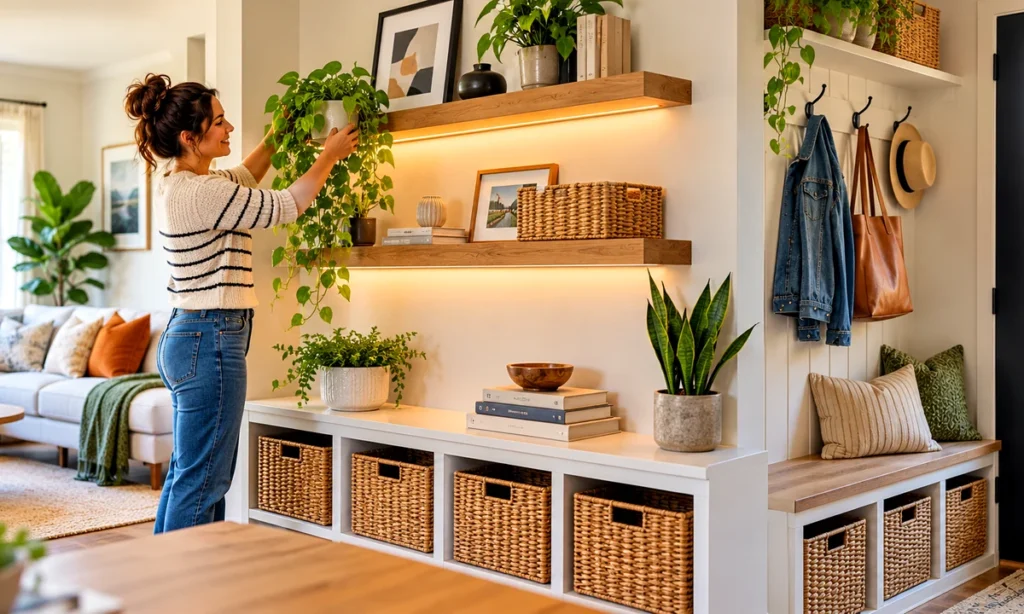
The entrance is where the day’s belongings compete for attention. Bags, coats, mail, keys, shoes, and delivery boxes often land in the same small area. Instead of trying to add a large cabinet, divide that area by routine. Keys need a small tray, coats need secure hooks, and shoes need a place that is easy to clean.
For a family, it helps to give each person a designated hook or cubby. Keep the most frequently worn shoes within easy reach and store extras elsewhere. A narrow bench may help with footwear, but not if it makes the doorway difficult to use or blocks the exit route.
Wall hooks and shelves must be fastened according to the wall type and manufacturer’s load limits. For renters, a freestanding rack or furniture with appropriate anti-tip measures may work better than drilling. Keep emergency paths clear and avoid hanging heavy bags where young children may pull them down.
5. Bathroom: prioritize moisture-safe access
Bathroom visible storage ideas should begin with a small number of clear categories: daily skincare, dental care, first aid, backup supplies, and cleaning tools. Use shallow washable bins beneath the sink, but leave plumbing and shutoff valves accessible. Keep medicines stored according to their labeling, since humid bathrooms may be unsuitable for some products.
Place everyday supplies where you can reach them without bending or stretching. Keep hazardous cleaning products in secure storage that children cannot access. Wipe trays periodically and replace any container that traps standing water or develops damage.
6. Home office: build a paper decision station
A drawer full of folders is not a complete system if incoming paper still covers the desk. Make a simple station with places for action needed, records to file, and material to recycle or shred. Label the categories plainly and choose a weekly time to empty the action tray.
Store sensitive documents and devices securely rather than leaving them on an open shelf. Digitize only when you have a suitable backup and a reason to retain the file. Important records may have legal or financial retention requirements, so do not use a generic decluttering checklist as a reason to discard them.
How to make practical storage feel beautiful
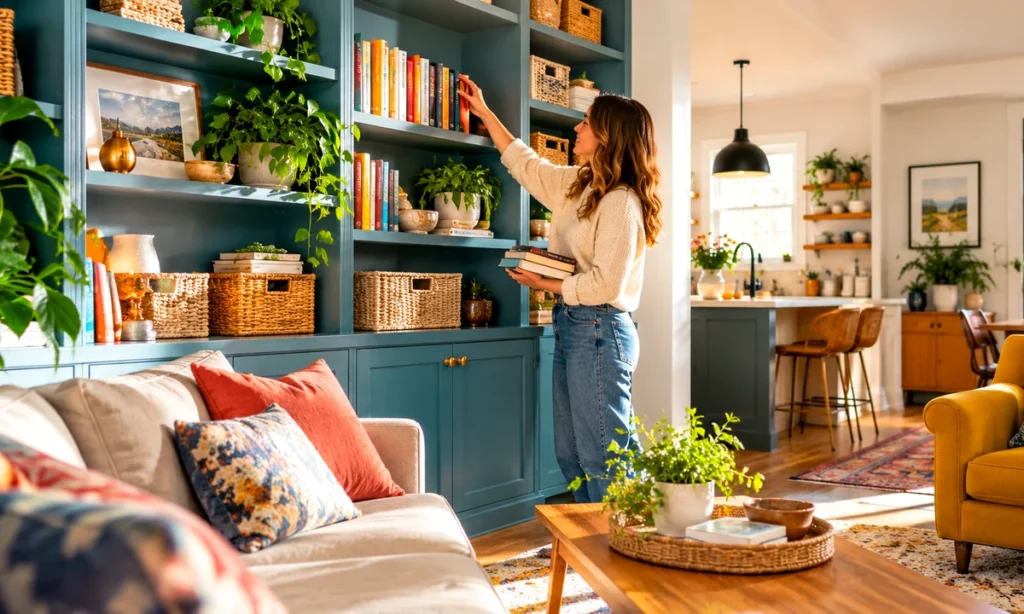
Vibrant rooms do not require every box to be a bright color. Start with a calm foundation of wood, cream, white, or another neutral you already like. Then repeat one or two richer accents through cushions, pottery, baskets, framed art, or a painted shelving unit. Teal, mustard, terracotta, and fresh green can give storage areas personality without making the room feel chaotic.
Mix open and closed storage based on what deserves attention. Family photographs, books, and favorite ceramics can remain visible. Batteries, cables, office supplies, and spare toiletries generally look calmer behind a door or inside a labeled bin. The goal is not perfection but a deliberate balance.
Use natural light where possible, and add focused lighting if a cupboard or desk is hard to see into. Avoid placing delicate objects where sunlight will damage them. A small lamp beside a shelf can make a room feel more welcoming, but cords should be routed safely and kept away from trip hazards.
Use color to explain the system
Color is useful when it communicates something. The strongest visible storage ideas rely on clear categories rather than color alone. Children may remember that art supplies go in the yellow basket and small games in the green one. In a pantry, neutral bins with clear labels may work better because the contents change frequently. For households with color-vision differences, pair color with words or recognizable icons rather than relying on color alone.
Do not buy a matching collection simply because the packaging promises an instant makeover. Containers with similar dimensions may stack neatly, but a uniform appearance is not the same as easy access. A mixture of older baskets and practical clear bins can work beautifully when each has a clear role.
A realistic weekend organization plan
A whole-house reset is rarely necessary. Pick one area where you spend unnecessary time every day. The schedule below is an example for a modest project; the right pace depends on the amount of sorting, household needs, and your available energy.
| Stage | Action | Goal |
|---|---|---|
| First 20 minutes | Photograph, empty and sort one problem area | See what you actually own |
| Next 20 minutes | Group contents by use and frequency | Decide which categories belong together |
| Next 15 minutes | Measure surfaces, openings and clearances | Avoid buying the wrong organizer |
| Next 25 minutes | Test existing trays, boxes and dividers | Create an easy-to-use layout |
| Final 10 minutes | Label, photograph and check access | Make the system repeatable |
These times are illustrative, not a promise. Sentimental items, household paperwork, disability, or years of accumulated belongings may call for a slower project. You can still finish by deciding which shelf or drawer will be next, without forcing the entire job into a single day.
Maintain it with a monthly five-zone reset
A monthly check helps prevent small problems from becoming large cleanouts. Review the entryway drop zone, pantry and refrigerator, paper station, bedroom clothing, and bathroom supplies. These are the same general areas emphasized in the October 26 Southern Living advice. You do not need to overhaul them each month. Remove expired or unneeded items, return misplaced belongings, and notice what no longer works.
Ask your household one practical question: What still takes too long to find or put away? Their answers are more useful than guessing from an attractive photograph. If everyone leaves shoes outside the assigned basket, the basket may be too far from the door or too small for the number of people who use it.
Common organizing mistakes to avoid
The first mistake is buying storage before sorting. That often produces empty containers in one room and overflowing categories in another. Measure and test after you understand the contents, then shop only for what the existing furniture cannot handle.
The second is choosing tall stacks for frequently used items. Stacks can be efficient for seasonal supplies, but daily objects should not require a balancing act. Vertical racks, accessible bins, or fewer items per shelf may be safer and easier.
The third is chasing a perfect color-coded look at the expense of convenience. A beautiful basket does not help if its lid is difficult to lift or the contents become invisible. Also avoid overly ambitious rules. A simple basket for each family member is often more sustainable than a complicated system of tiny categories.
Finally, review safety. Do not overload shelves, obstruct air vents or exits, hide shutoff valves, or place heavy objects above seating. Anchor furniture when required by its instructions and local conditions. Professional assistance is appropriate when a storage project involves structural changes, questionable walls, or electrical work.
Frequently asked questions
Are visible storage ideas better than hidden storage?
Neither approach is universally better. Open storage works well for beautiful or frequently used items, while closed storage helps contain visually busy collections. Most homes benefit from a combination that reflects how each room is used.
What should I organize first in a small home?
Start with the place that causes the most daily friction. For many households it is an entryway, a kitchen cabinet, or a clothing drawer. Fixing one repeating problem is more useful than purchasing a large set of organizers without a plan.
Do clear bins always work best?
No. Clear bins are useful when you need to identify contents quickly, but attractive opaque baskets may suit visible living-room shelves better. Whatever you choose should be comfortable to carry, easy to clean, and suitable for its contents.
Can renters use these storage ideas?
Yes. Drawer dividers, freestanding shelves, trays, storage ottomans, and movable bins can provide substantial improvements without drilling. Check lease terms, furniture safety, and any required anti-tip precautions before changing the layout.
How often should I reset my storage systems?
A brief weekly tidy works for many busy areas, while a monthly check can catch expired supplies, paperwork, and clothing that has accumulated. Reassess the system after a move, a new family routine, or another change in how the room is used.
How can I make a storage wall look vibrant without feeling messy?
Repeat a limited palette, group items into small collections, and leave some open space. Use one or two statement colors with natural materials, then hide the most visually cluttered supplies in closed containers.
The bottom line
At their best, visible storage ideas are not about filling every available inch. They are about keeping daily belongings obvious, reachable, and easy to return while creating a home that feels personal. Start with one cabinet or shelf, measure before buying, and judge the result by daily use rather than its appearance in a single photograph.
Recent October 2026 coverage highlights an approach that can remain helpful long after the news cycle moves on. Better storage should make life simpler and leave room for the people, routines, and objects that make your home yours.