
Tesla’s new Roadster has finally left the ground. At an October 15 event in Texas, the long-awaited electric sports car drove upside down, jumped over other vehicles, and turned in the air before landing on its wheels. It looked like something from a science fiction movie, except the stunt happened in front of an audience.
The Tesla flying car headlines are understandable, but they leave out an important detail. Tesla demonstrated brief, controlled airborne maneuvers, not a car that can take off from your driveway and fly across town. The technology is real enough to be worth explaining, while its everyday usefulness remains unproven.
Here’s what Tesla showed, how the system works, when the Roadster might reach buyers, and which questions still need answers.
Table of Contents
Tesla Flying Car Reveal: What Happened on October 15, 2026?
Tesla unveiled the redesigned second-generation Roadster at a SpaceX test facility in McGregor, Texas. The show focused on two unusual systems, one that creates suction beneath the car and another that releases pressurized gas through thrusters placed around it. The demonstration combined those systems with an electric sports car built for extreme performance.
In one sequence, a white Roadster climbed a large curved ramp and continued along the section that turned upside down. It then left the ramp, rotated in midair, and landed upright using its thrusters. Another demonstration sent the car up and over a lineup of Tesla vehicles.
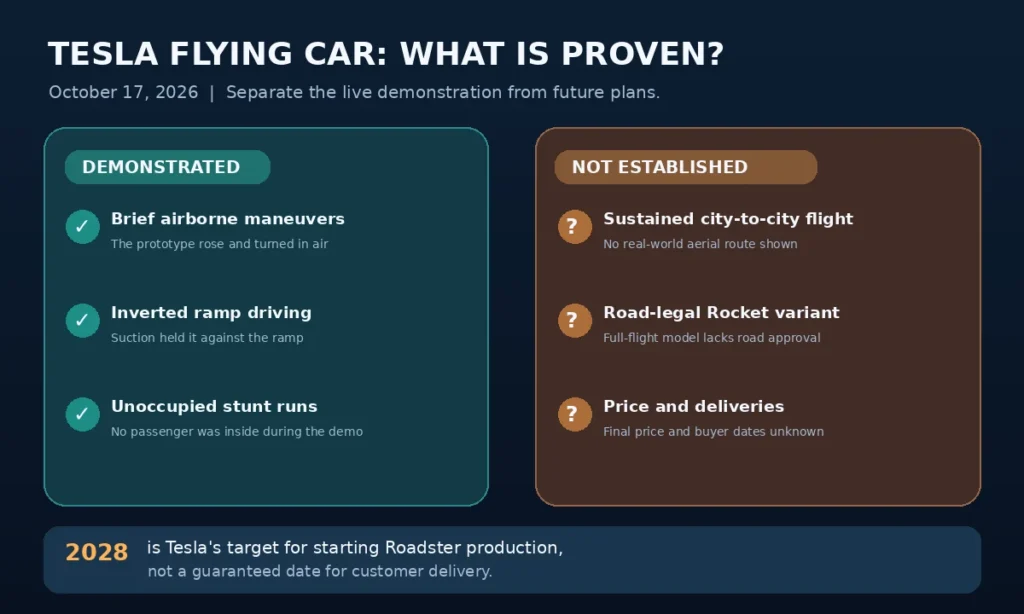
No one was sitting inside the car during the demonstrations. Tesla used an unoccupied vehicle as a safety measure, rather than having a driver attempt these experimental maneuvers. That distinction matters because the demonstration was not a test of a consumer driving experience.
You can see the event on Tesla’s Roadster livestream page. Independent reports from Reuters and Associated Press describe the same core demonstration.
Is the Tesla Flying Car Really Flying?
It depends on what you mean by flying. The Roadster clearly left the ground and controlled some of its movement using onboard thrust. That is more than an ordinary sports car can do, and it goes beyond a simple jump off a ramp.
But a few seconds of airborne control are not the same as sustained flight. Tesla has not publicly demonstrated this Roadster cruising through the air over a meaningful distance, following an aerial route, or carrying a passenger through a repeatable flight.
| What people are asking | What the October demonstration showed |
|---|---|
| Did the car leave the ground? | Yes, during short, controlled stunts. |
| Did it change its position in the air? | Yes, using gas thrusters. |
| Did it drive upside down? | Yes, on a specially built curved ramp using suction. |
| Can it fly across a city? | That capability was not demonstrated. |
| Can buyers use it on public roads? | The full-flight Rocket version is not approved for public road use. |
| Is the vehicle in production? | No. Tesla is targeting production in 2028. |
The fairest description is a thruster-equipped electric Roadster prototype capable of short airborne maneuvers. It is impressive engineering, but calling it a practical flying car today would go beyond the available evidence.
The images accompanying futuristic technology stories also deserve a closer look. A realistic illustration can make an experimental vehicle appear ready for everyday use, even when it isn’t. The featured image in this article is concept art, not a photograph of Tesla’s prototype. If you’re curious about how these visuals are created, our guide to Nano Banana image prompts includes an example of creating realistic science-fiction product concepts.
How Does Tesla’s New Roadster Get Into the Air?
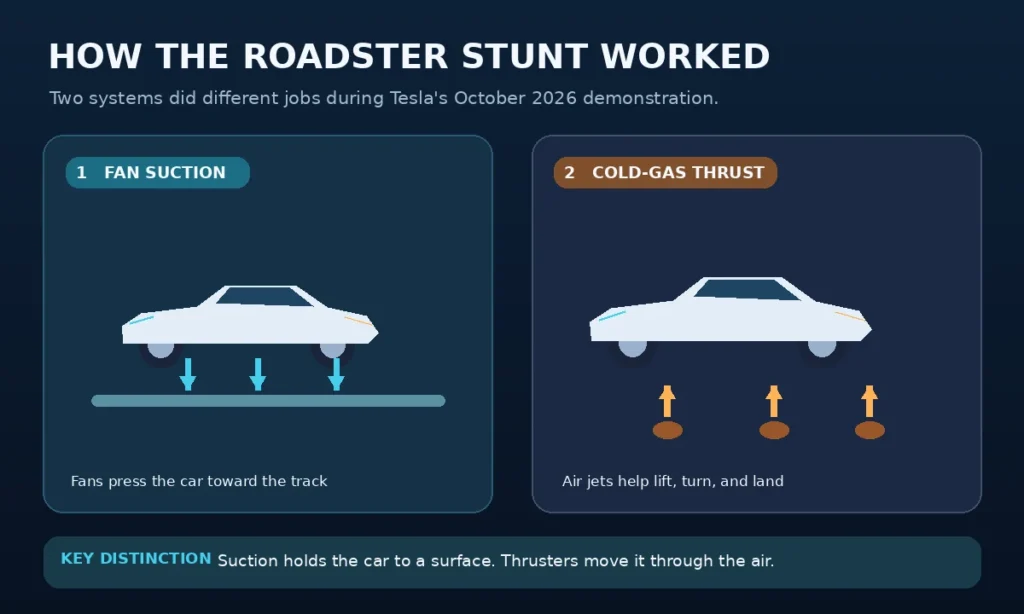
The stunt involved two different technologies. They sound similar in headlines, but they perform different jobs. Understanding the distinction helps explain how a car could drive upside down and then move through the air.
Cold-gas thrusters provide short bursts of force
Instead of burning rocket fuel, the Roadster’s experimental Rocket configuration stores air under very high pressure. When that gas is released through nozzles, it produces thrust. By directing that thrust, the system can help push the car upward or sideways and change its orientation.
This is the SpaceX-inspired part of the design. Car and Driver’s technical explanation describes a prototype system with multiple nozzles and large compressed-air tanks. The setup used for the extreme stunt takes up space that would otherwise be available to a passenger.
The important limit is energy and stored gas. A burst powerful enough for a jump or flip does not automatically mean the car can stay aloft for an extended period. Tesla has not provided evidence that the demonstration system can support practical point-to-point flight.
Fans create suction beneath the car
The other trick is a ground-effect suction system. Powerful fans reduce air pressure beneath the car, helping press it against the surface below. This can increase grip during driving and, with the specially prepared surface used in the reveal, allow the car to stay attached while inverted.
That is how the Roadster moved along the upside-down part of the demonstration ramp. It was not floating there because of the thrusters. The fans held the car against the ramp until it transitioned into the airborne stunt.
The two systems serve different purposes. Suction increases contact with a surface, while thrusters can move a vehicle when its tires are no longer touching one.
The electric drivetrain still does the normal driving
Underneath the experimental features, the Roadster remains an electric sports car. Its battery and electric motors propel it along the road, while the extra systems are intended for unusual performance and handling maneuvers.
That matters because the airborne demonstration does not turn Tesla into a conventional aircraft maker overnight. Most of what a buyer would use in daily driving would still depend on the car’s ordinary road-going systems.
Tesla Roadster Performance, Thrust, and Rocket Versions
Tesla described several configurations around the October reveal. They should not be treated as one identical product, because the most spectacular equipment belongs to the most specialized version.
| Version | What has been described | Key limitation |
|---|---|---|
| Performance | The road-focused electric sports car | Final purchase price and delivery timing are not confirmed. |
| Thrust | Higher-performance version with acceleration thrusters | Final specifications and local road approval may affect what reaches buyers. |
| Rocket | An invitation-only configuration with a full flight system | Not approved for public road use and designed around an extreme single-seat arrangement. |
These descriptions reflect information reported following the reveal, not a guarantee that every proposed feature will reach production. Different configurations may also have different equipment, passenger space, and legal restrictions.
The takeaway is simple. Watching the Rocket prototype leap over cars does not mean every Roadster reservation includes the same capability.
How Fast Is the New Tesla Roadster?
Tesla says the redesigned Roadster can accelerate from 0 to 60 mph in less than one second. It also described a top speed above 230 mph and driving range above 300 miles. These are company-reported targets or demonstrations, not independently verified specifications for cars delivered to customers.
Those figures need context. A recorded demonstration at a controlled venue is different from consistent performance in daily conditions. Acceleration may depend on the configuration, tire grip, battery state, road surface, and other test factors.
There is also an important difference between the new claims and older information that remains online. Tesla’s older Roadster webpage has displayed figures such as 1.9 seconds to 60 mph, a top speed above 250 mph, and a projected 620-mile range. Those earlier figures come from the previous concept period and should not be blended with the October 2026 reveal.
Until Tesla publishes final production specifications and independent reviewers test a customer vehicle, the numbers should be presented as claims rather than settled performance records.
How Much Will the Tesla Flying Car Cost?
Tesla did not announce a final purchase price for the redesigned Roadster at the event. That is the most important fact for anyone searching for the cost of the new flying Tesla.
After the reveal, Reuters reported reservation amounts of $50,000 for the Performance version and $250,000 for the Thrust version. The Rocket configuration was described as invitation-only. Those numbers refer to deposits, not the final price of a finished car.
Deposits also do not guarantee a delivery date. Before reserving, buyers should read Tesla’s latest reservation terms carefully and check which configuration, features, cancellation rules, and refund conditions actually apply.
Claims that the flying Roadster costs exactly $200,000 or $250,000 should be treated with caution. Earlier price references and current reservation amounts do not establish the final selling price of the new vehicle.
When Will Tesla’s Flying Roadster Be Released?
Elon Musk said Tesla plans to begin Roadster production in 2028. That is a target, not confirmation that a customer will receive one in that year.
The second-generation Roadster was first presented in 2017, when Tesla described ambitious performance goals and a planned 2020 delivery timeline. Several delays followed. The redesigned 2026 prototype is an important new demonstration, but Tesla still has manufacturing, safety, and approval work ahead.
There is a wide gap between making one carefully prepared vehicle perform a stunt and building a reliable product at scale. Buyers should watch for a final production design, confirmed specifications, a published purchase price, relevant approvals, and actual deliveries.
Can You Legally Drive or Fly a Tesla Roadster on Public Roads?
The Rocket configuration with the full flight system is not approved for public road use. Tesla has also acknowledged that allowing a car to suddenly rise into the air presents legal and safety problems, even if the vehicle can perform the maneuver on a closed course.
A road vehicle must meet applicable vehicle safety rules. Using it as an aircraft would raise a different set of questions about airspace, operating conditions, and certification. Tesla has not shown that the Roadster can meet all the requirements for ordinary road-to-air travel.
The demonstration also used an unoccupied car. That kept a human driver out of the riskiest part of the stunt, but it means we have not seen the same sequence safely repeated with a passenger on board.
This is not a minor detail. A short burst of thrust near other cars, people, or buildings could create hazards that are absent from a managed test facility. Practical adoption will depend on much more than whether the hardware can produce enough force.
Why the New Roadster Matters Even If It Never Becomes a Flying Car
The Roadster reveal shows how electric cars and aerospace engineering can overlap. High-powered fans, active aerodynamics, advanced controls, and precise thrusters are unusual combinations for an automobile. Tesla and SpaceX have used them to test what a sports car can physically do.
There may be lessons for performance driving and vehicle engineering even if consumers never use the full airborne system. At the same time, this Roadster is positioned more as a showcase of technical ambition than an affordable transportation product.
There is another reason to keep expectations measured. A sports car that briefly jumps over obstacles is not a solution to traffic congestion, city transport, or personal aviation. Solving those problems would require repeatable, efficient flight, passenger safety, suitable infrastructure, and a workable regulatory system.
That does not make the demonstration meaningless. It means the most useful question is not simply “Did Tesla make a car fly?” It is “Which parts of this technology can become safe, reliable products?”
Tesla Flying Car FAQ
Has Tesla actually made a flying car?
Tesla demonstrated a Roadster prototype that can leave the ground briefly and control movement using compressed-gas thrusters. It has not demonstrated sustained, practical air travel or released a road-legal flying car for customers.
Did the Roadster really drive upside down?
Yes. During the October 15, 2026 event, the prototype drove along an inverted section of a specially designed ramp. A fan-powered suction system helped hold it to that surface.
Does the Tesla Roadster use rocket fuel to fly?
The demonstrated thrusters use stored, highly pressurized gas rather than burning rocket fuel. Releasing the gas through nozzles creates short bursts of force that help lift, turn, or stabilize the prototype.
Will every new Tesla Roadster be able to fly?
No such promise has been established. The full-flight system is associated with a specialized Rocket configuration, which Tesla describes as invitation-only and not approved for public roads.
What is the Tesla flying car release date?
Tesla says it aims to begin Roadster production in 2028. That is a proposed production start, not a confirmed date for customer deliveries or for a street-legal flying version.
Is there a confirmed price for the flying Roadster?
No final purchase price was announced at the October event. Reported reservation deposits for different versions should not be mistaken for the vehicle’s selling price.
The Bottom Line
The new Tesla Roadster has done something remarkable in public. Its combination of suction fans and compressed-gas thrusters let a prototype drive upside down, rise into the air, change orientation, and land. Those were real demonstrations of experimental vehicle engineering.
For now, though, the Tesla flying car is better understood as a high-performance prototype with brief airborne capability, not a transportation breakthrough ready for everyday use. Production is only targeted for 2028, the final price is unknown, and the full-flight configuration is not approved for public roads.
The next important milestone will not be another dramatic video. It will be verified production specifications, safety evidence, regulatory clarity, and a vehicle that customers can actually receive.
Sources and Further Reading
- Tesla – Roadster livestream
- Reuters – Tesla’s new Roadster turns in air with SpaceX thrusters
- Associated Press – Tesla’s Roadster can thrust itself into the air
- Car and Driver – How the Roadster’s thrusters and fans work
- Tesla – Roadster website (contains earlier concept figures)
For more coverage of experimental vehicles, emerging inventions, and technological breakthroughs, explore our Future Tech & Innovations section.