
If you spend enough hours in bed but still wake up tired, the issue may involve sleep quality, not just bedtime. Sleep quality includes how readily you fall asleep, whether sleep is repeatedly interrupted, and how rested you feel the next day. A consistent schedule, a comfortable bedroom, and realistic daytime habits may help. This guide explains what to change first, what to avoid, and when poor sleep deserves professional assessment.
The CDC’s sleep guidance says adults ages 18 to 60 generally need at least seven hours of sleep per night, while recommended ranges vary for older adults. Hours alone are not the whole story. Good sleep quality also involves sufficient, restorative sleep with fewer disruptive awakenings. No routine can promise perfect sleep every night.
In this guide
- What affects sleep quality most?
- Seven daytime habits that support sleep quality
- Create a 60-minute routine for better sleep quality
- Set up a bedroom that is easier to sleep in
- What a sleep diary can reveal
- Common mistakes when trying to improve sleep quality
- When poor sleep quality needs treatment
- The bottom line
What affects sleep quality most?
Sleep responds to several interacting factors. Your internal body clock is influenced by light and timing. Caffeine, alcohol, some medicines, pain, stress, and breathing problems may also affect how well you sleep. Bedroom noise and temperature can interrupt sleep even when you follow a bedtime ritual.
Before buying a tracker or supplement, look at patterns for a week. Do you go to bed at very different times? Are you sleepy during the day? Does your partner notice loud snoring or pauses in breathing? Such details can help identify which change is worth trying, or whether a healthcare professional should evaluate your symptoms.
Improving sleep quality often requires steady habits rather than one dramatic intervention. Make one or two changes at a time so you can tell whether they are helpful.
Sleep also belongs to a broader set of healthy aging habits that support daily independence.
Seven daytime habits that support sleep quality
1. Choose a consistent wake-up time
A regular wake time gives the day a reliable anchor. Try to keep it reasonably similar on weekdays and weekends, even if your bedtime sometimes changes. If your schedule involves shift work, a clinician or occupational sleep specialist may be able to suggest a different strategy.
2. Seek daylight during the day
Natural light helps signal the timing of wakefulness to the body. Spend time outdoors when appropriate or sit near a bright window, particularly earlier in your waking period. Protect your eyes and skin according to conditions rather than staring into sunlight.
3. Move regularly, but adapt timing
Walking, cycling, and other suitable activity support general health and may also support sleep. If intense late-night exercise leaves you alert, try an earlier workout. There is no need to avoid all evening movement if it does not disturb your rest.
4. Pay attention to caffeine timing
Caffeine can stay in the body for hours, and sensitivity varies. If falling asleep is difficult, move coffee, energy drinks, or strong tea earlier in the day or reduce the amount. Read labels because caffeine can appear in products beyond coffee.
5. Keep naps intentional
Short naps may help some people, especially when they are sleep deprived. Long or late naps can make it harder to sleep at night for others. If naps affect your bedtime, experiment with shortening them or moving them earlier.
6. Limit alcohol as a sleep strategy
Alcohol can make some people sleepy initially while contributing to later sleep disruption. Using it to induce sleep is not a reliable way to improve sleep quality. If you are concerned about alcohol use, seek appropriate healthcare support.
7. Leave room to wind down
A little transition time matters. Finishing work, reducing demanding conversations, and preparing tomorrow’s essentials before bed can make the evening less hurried. You do not need an elaborate routine, just a repeatable cue that the day is ending.
For pressure that follows you into the evening, consider our practical stress management techniques.
Create a 60-minute routine for better sleep quality
The timeline below is an example for someone who wants to be in bed around 10:30 p.m. Adjust the times for your responsibilities and natural sleep schedule rather than forcing a particular clock time.
| Time | Suggested action | Purpose |
|---|---|---|
| 9:30 p.m. | Finish nonurgent tasks and set out morning essentials | Reduce unfinished-business worries |
| 9:45 p.m. | Dim bright lighting and quiet unnecessary alerts | Make the environment less stimulating |
| 10:00 p.m. | Wash up, read, or listen to calm audio | Repeat a familiar wind-down cue |
| 10:15 p.m. | Check that bedroom is quiet, dark, and comfortable | Remove avoidable disturbances |
| 10:30 p.m. | Go to bed when sleepy | Associate bed with sleep |
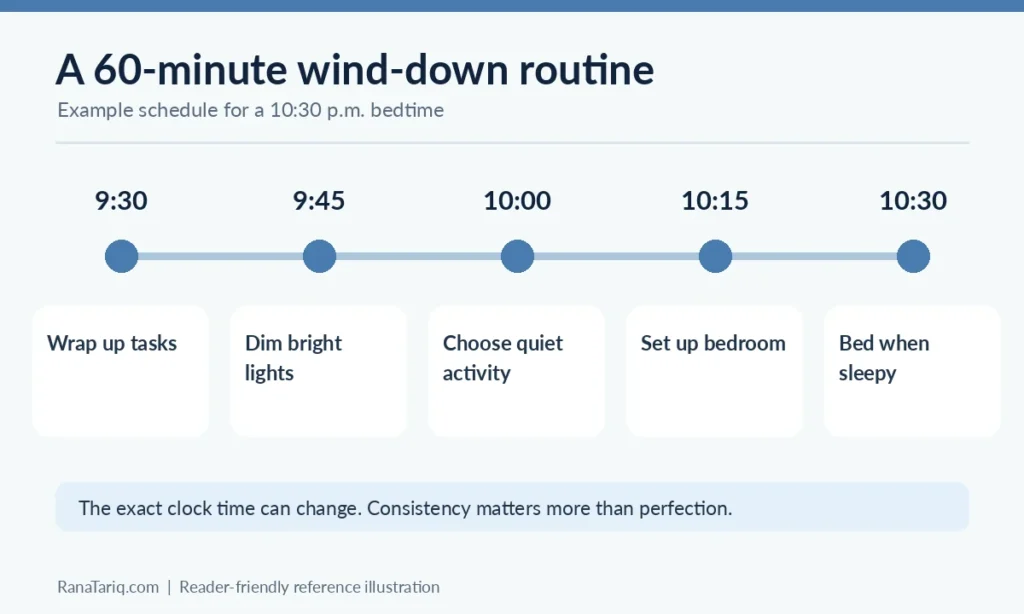
Some people find that a warm shower, easy stretching, or quiet reading helps. Others prefer a shorter routine. Do not interpret one difficult night as proof that the plan failed. The goal is to support sleep quality consistently, not to control the exact minute you fall asleep.
Set up a bedroom that is easier to sleep in
A dark, quiet, comfortable room is a useful starting point. Blackout curtains, a sleep mask, or earplugs may help where appropriate. Choose bedding and a room temperature that feel comfortable. There is no universal temperature that works for every household or season.
Think about your phone as well. The issue is not merely whether a screen exists, but whether its light, alerts, or content keeps you engaged. Charging your phone away from the bed or using a do-not-disturb setting may help you stop checking it repeatedly. Keep any necessary emergency contact method available.
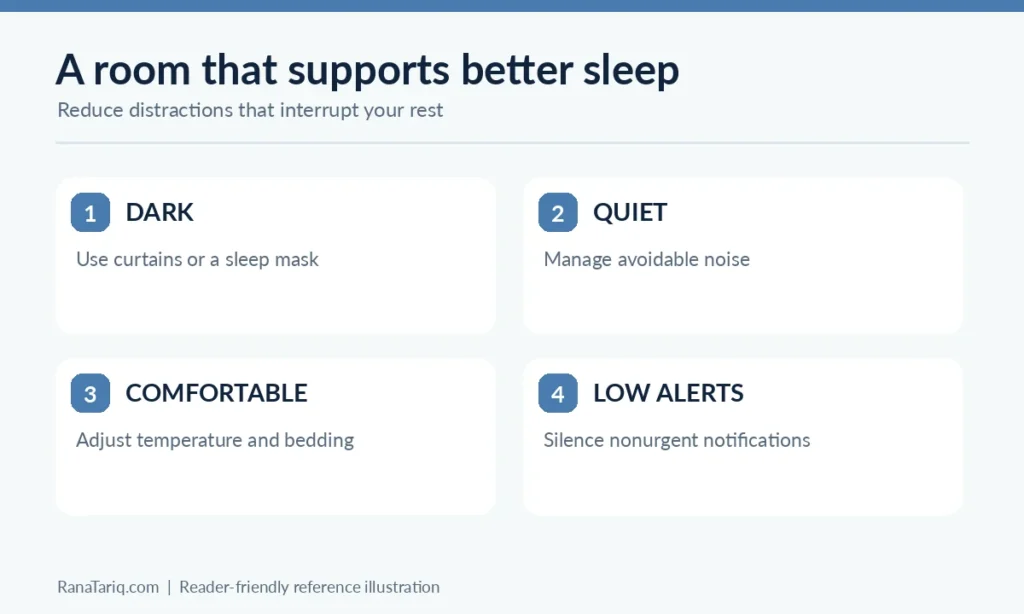
If you share a room, discuss noise, lights, and differing schedules rather than expecting one person’s preferences to work for both. Children, caregiving, and shift work may limit how much control you have. Practical improvements still count even when the room cannot be perfect.
What a sleep diary can reveal
For seven to fourteen days, record your approximate bedtime, wake time, naps, caffeine use, nighttime awakenings, and how rested you feel. Do not obsess over every minute. The purpose is to identify patterns and give a clinician useful context when needed.
You may notice that later caffeine corresponds with difficulty falling asleep, or that long weekend sleep-ins make Sunday night harder. These observations are clues, not proof of cause and effect. Use them to select one reasonable change to test.
Wearable devices can estimate sleep stages, but consumer measurements are not the same as a clinical sleep study. Avoid treating a low “sleep score” as a diagnosis. If you feel rested and function well, a device’s number may not deserve much attention.
Common mistakes when trying to improve sleep quality
Trying to force sleep. Watching the clock and demanding immediate sleep can increase frustration. Follow a calm routine and seek clinical guidance if insomnia persists.
Sleeping in for hours every weekend. Large schedule shifts can complicate timing for some people. A reasonably consistent wake time is often more useful.
Using supplements as the first answer. Sleep supplements are not risk-free, and the appropriate option depends on the cause of the problem. Ask a clinician or pharmacist about safety and interactions.
Ignoring snoring or breathing pauses. Loud snoring, gasping, or witnessed pauses in breathing may suggest sleep apnea and deserve medical evaluation. Bedroom adjustments alone will not diagnose or treat it.
Assuming more time in bed always helps. Spending excessive time awake in bed may make persistent insomnia harder to manage. People with chronic insomnia may benefit from structured treatment rather than simply extending bedtime.
When poor sleep quality needs treatment
Talk with a healthcare professional if sleep problems last, cause daytime impairment, or involve heavy snoring, choking, restless legs, marked mood changes, or dangerous sleepiness. Do not drive when you are too sleepy to do so safely. Sudden severe symptoms require appropriate urgent care.
For chronic insomnia, the National Heart, Lung, and Blood Institute identifies cognitive behavioral therapy for insomnia, or CBT-I, as a usual first treatment option. CBT-I is a structured therapy that addresses sleep-related thoughts and habits. It is different from simply following a list of generic sleep tips, and the techniques should be used with professional guidance when appropriate.
Frequently asked questions
How many hours do adults need for good sleep quality?
Adults ages 18 to 60 generally need at least seven hours. Older adult recommendations differ, and individual needs vary. Restorative sleep and daytime functioning matter alongside duration.
Will putting my phone away fix poor sleep?
It can help when notifications, bright light, or engaging content delays bedtime. It will not treat conditions such as sleep apnea, chronic insomnia, or pain that interrupts sleep.
Are sleep trackers accurate?
Consumer trackers offer estimates and may help identify routines, but they are not substitutes for clinical assessment. Avoid making medical decisions from a sleep score alone.
What if I wake up several times each night?
Occasional awakenings can occur. If they are frequent, distressing, or followed by daytime impairment, discuss possible causes such as medicines, pain, breathing problems, or insomnia with a clinician.
Should I take melatonin every night?
Do not assume nightly melatonin is necessary or appropriate. Its usefulness and safety depend on the situation and your medical history, so discuss ongoing use with a qualified healthcare professional.
The bottom line
Better sleep quality begins with consistent wake times, sensible daytime habits, and a bedroom that supports rest. Make small changes, observe whether they help, and seek assessment for persistent or troubling symptoms. Good sleep is a health priority, not a score you need to win every night.