
Strength training at home does not require a rack of weights or an expensive membership. Beginners can build a useful routine with a sturdy chair, a little floor space, and movements such as squats, wall push-ups, and hip hinges. The key is to learn comfortable form, allow recovery time, and make exercises gradually more challenging. This guide explains how to start, what to do each week, and when to adjust the plan.
The World Health Organization’s activity guidelines recommend muscle-strengthening activity involving major muscle groups on at least two days a week for adults, alongside aerobic movement. You can build toward that goal from your current ability. If you have an injury, uncontrolled medical condition, or symptoms during activity, ask a qualified clinician what is appropriate for you.
In this guide
- Why strength training matters beyond muscle size
- The five movement patterns in a beginner strength training plan
- Your four-week strength training schedule
- How to tell when you are ready to progress
- Common mistakes with strength training at home
- Make strength training fit your actual week
- The bottom line
Why strength training matters beyond muscle size
The benefits of strength training are not limited to lifting heavier objects. Stronger legs make standing from a chair easier. Stronger hips and back can help with ordinary tasks such as carrying groceries, and upper-body strength makes pushing and pulling easier. Exercise also helps protect physical function as people age, although individual results depend on health, consistency, and the exercises chosen.
For a new exerciser, the most useful measure is often an everyday task. Can you rise from a chair more smoothly? Can you complete an extra controlled repetition without holding your breath? Progress may appear there before you notice a change in the mirror. This is one reason a simple home routine can be worthwhile even without specialized equipment.
Strength training should be challenging enough to require effort but not so difficult that each set becomes a struggle. A little muscle fatigue is normal. Sharp pain, dizziness, chest discomfort, or unusual shortness of breath is a reason to stop and seek appropriate medical advice.
The five movement patterns in a beginner strength training plan
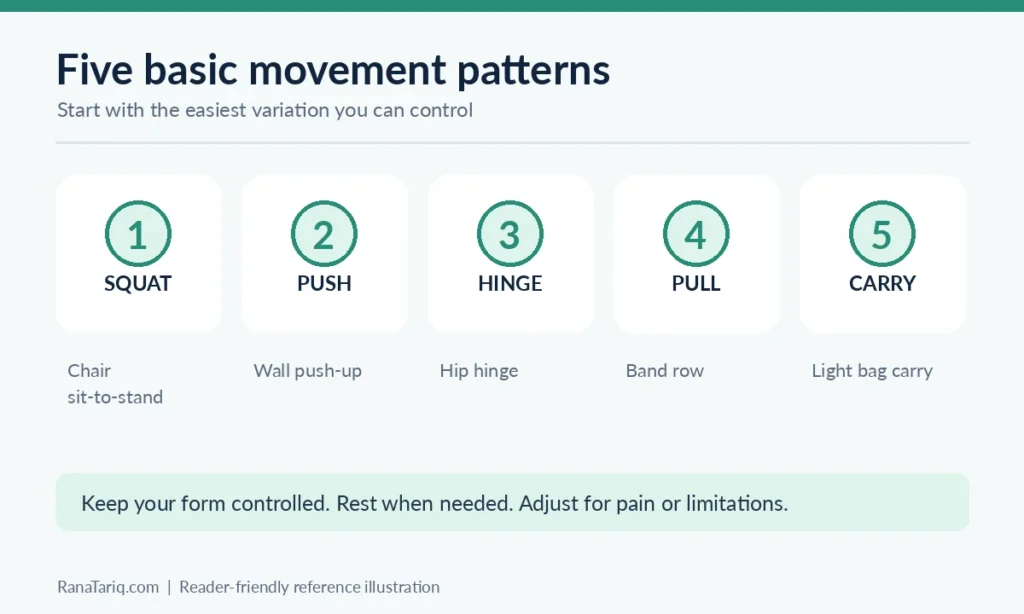
Rather than collecting random exercises, cover the movement patterns your body uses throughout the day. The following choices need little equipment and have easier or harder versions.
| Movement | Beginner exercise | Easier option | How to progress |
|---|---|---|---|
| Squat | Sit-to-stand from a chair | Use a higher chair or hand support | Lower the chair height or hold a light weight |
| Push | Wall push-up | Stand closer to the wall | Move to a countertop, then a sturdy bench |
| Hinge | Hip hinge with hands on hips | Practice a smaller range | Add a light backpack when form is reliable |
| Pull | Resistance-band row | Use a lighter band | Increase band resistance gradually |
| Core and carry | Suitcase carry with one light bag | Carry two light bags briefly | Add walking time or modest weight |
There is no need to perform every variation. Choose the level where your movements feel controlled and you could still do roughly two more repetitions at the end of a set. This is a practical starting rule, not a medical target or a requirement to train to exhaustion.
How to perform the movements safely
For a chair squat, plant your feet comfortably apart, lean forward slightly, stand up, and sit down slowly. Keep a stable chair against a wall. For a wall push-up, place your palms on the wall, bend your elbows with control, then push away. Avoid letting your lower back sag.
A hip hinge is a backward movement of the hips, not a deep bend through the waist. Keep your spine in a comfortable, neutral position and practice without weight. For rows, anchor a resistance band only to a secure point and inspect it for wear. If no safe anchor is available, skip that move until you have one.
Your four-week strength training schedule
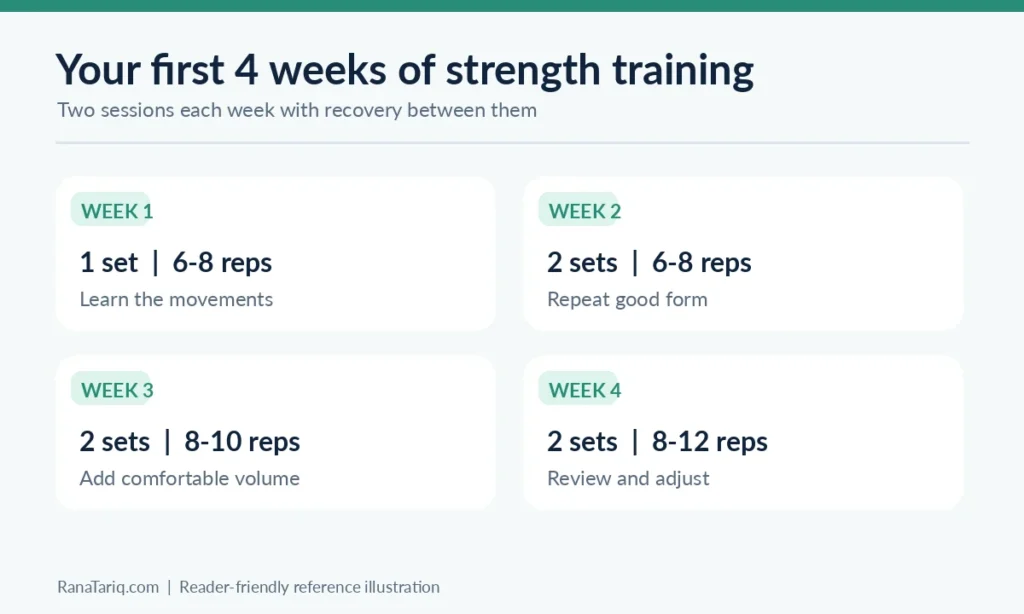
This introductory strength training schedule uses two nonconsecutive workout days. Walking or another comfortable aerobic activity can fill other days, but it is not necessary to make each day intense. Treat the numbers as a starting framework that can be adjusted to ability.
| Week | Workout days | Sets per exercise | Repetitions or duration | Main goal |
|---|---|---|---|---|
| 1 | Monday and Thursday | 1 | 6 to 8 controlled reps, or 20-second carry | Learn the motions |
| 2 | Monday and Thursday | 2 | 6 to 8 reps, or 20-second carry | Repeat good form |
| 3 | Monday and Thursday | 2 | 8 to 10 reps, or 30-second carry | Add comfortable volume |
| 4 | Monday and Thursday | 2 | 8 to 12 reps, or 30-second carry | Evaluate readiness |
Start each session with five minutes of easy movement, such as walking around the room and gently moving your shoulders and hips. Complete the five chosen exercises, resting as needed between sets. Finish with a few minutes of relaxed walking. Many beginners will complete this in roughly 15 to 30 minutes, depending on rest and modifications.
If the first week feels hard, repeat it instead of pushing ahead. If a movement causes joint pain, change the range, resistance, or exercise. Successful strength training comes from a routine you can recover from, not from following a calendar at any cost.
How to tell when you are ready to progress
Three signals are useful: you can finish the planned repetitions with stable form, your breathing returns to normal during rests, and your next session does not start with unusually heavy soreness. When those conditions hold, change only one variable at a time. Add a couple of repetitions, then another set, or choose a slightly harder exercise.
You do not need to add weight every workout. Sleep, work demands, medications, and recovery affect how a session feels. Record the exercise, version, sets, repetitions, and any discomfort in a notebook. If progress stalls for a week, the log may show that you need more recovery rather than more effort.
The WHO also recommends 150 to 300 minutes of moderate aerobic activity per week for adults, or an appropriate equivalent, but people who are inactive should start with smaller amounts and build gradually. Strength training and walking are complementary. One builds strength while the other supports endurance and general activity.
Common mistakes with strength training at home
Doing too much in week one. Starting with daily hard sessions can make soreness the main feature of your routine. Begin with two manageable days and leave time between them.
Rushing every repetition. A fast set can hide poor control. Use a pace that lets you stop safely at any point, especially when standing from a chair or moving a band.
Ignoring the pulling pattern. Push-ups and squats are easy to remember, but back muscles need attention too. Add a safe band row or another suitable pulling exercise when available.
Treating soreness as proof. Muscle soreness is neither required nor a reliable measure of progress. Better control and gradually improved performance are more helpful signs.
Following someone else’s difficulty level. A workout designed for an experienced lifter may be wrong for a beginner. Your starting variation should match your current mobility, strength, and health needs.
Make strength training fit your actual week
One practical approach is to attach workouts to predictable events. For example, exercise after breakfast on Monday and Thursday, before the day becomes busy. Keep the chair and band where they are easy to reach, and use a calendar checkmark after each session. A missed day does not cancel the plan. Return to the next convenient nonconsecutive day.
Think of the first month as practice rather than a transformation challenge. By the end, you should know which movements suit you, which need modification, and how much rest you prefer. That information will help you decide whether to continue at home, add equipment, or ask a certified trainer to check your technique.
Frequently asked questions
Is twice a week enough for a beginner?
Two days of strength training can be a sensible starting point and aligns with the WHO recommendation for muscle-strengthening activity on at least two days weekly. Your exercise selection and effort still matter, and additional training is not automatically better.
Can I begin without dumbbells?
Yes. Chair squats, wall push-ups, and unweighted hip hinges are useful ways to practice. A resistance band can help with pulling movements, but it should have a secure anchor and be in good condition.
Should I exercise if my muscles are sore?
Mild soreness may allow easier activity, but persistent or intense pain is a reason to rest and reconsider the program. Avoid pushing through joint pain, and seek medical advice for worrying symptoms.
How quickly will I notice changes?
Some people notice smoother movements or improved confidence within several weeks. Visible muscle changes vary widely, so there is no dependable universal timeline.
Is this plan appropriate for older adults?
Many exercises can be adapted, but older adults may also benefit from balance work and individualized fall-prevention advice. The CDC’s guidance for older adults explains the mix of aerobic, strength, and balance activity.
The bottom line
Begin strength training with simple movements, two nonconsecutive sessions, and a clear way to make each exercise easier. Consistency and safe progression matter more than the amount of equipment in the room. After four weeks, keep the movements that work, adjust those that do not, and build from your own starting point.